Getting startedGuide
How to bring users to CheapTokens: 6 practical ways
Where to publish, what to show, where to put your partner link and how to compare channels — six ways for a new partner, with examples.
On this page
The CheapTokens partner program pays you 10% of every top-up made by the people you bring — with no time limit and no cap. The reward goes to your partner balance and becomes available after a hold: you can move it to your API balance or withdraw it in USDT on the TRON network. Below are six ways to recommend the service so that people actually start using it.
People sign up when they see the service solve their own task. A link with a demo, a working config or a real cost figure works better than a link alone.

Where your link is#
Sign in and open the Partner program tab in your dashboard. The link looks like https:/ — you can change its ending to a word of your own (your previous links keep working) and copy it with one button. For each place where you post, add a campaign: the link gets a label such as ?c=youtube, and the tab shows the results of each campaign separately.
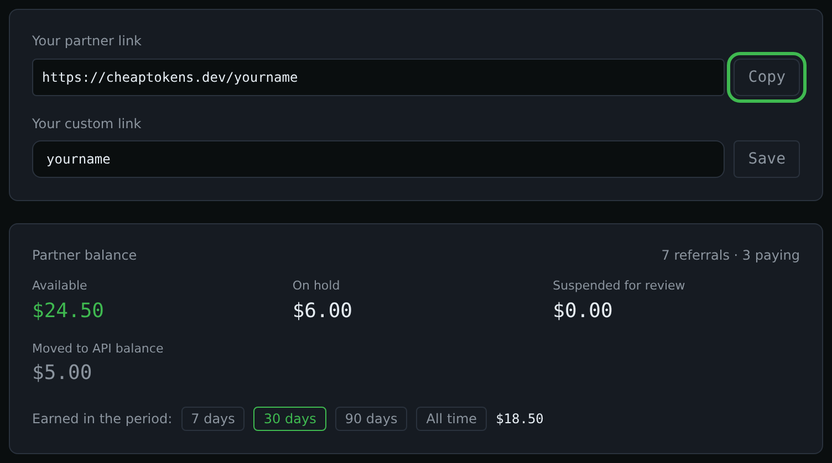
The first click on your link opens a 30-day window. If the person creates an account within it, they stay with you permanently — even before a top-up.
1. Recommend it to developers and teams you know#
Find someone who already pays for an AI API — a colleague who runs an agent, a team that uses Cline or Aider every day. Show them one concrete scenario and help with the setup.
- Topic example: “We moved our coding agent to GLM-5.3-Flash — here is the config and the bill for a week.”
- Message example: “You use Cline with an OpenAI-compatible provider. CheapTokens serves the same open-weight models at fixed USD prices; setup is a base URL and a key, here is the guide. My link: …”
- Where the link goes: at the end of the message, after the setup steps.
- What to measure: how many of the people you wrote to signed up and topped up.
2. Write a practical article#
A setup guide is the most useful format: it answers a question people already search for. Publish it on your own blog, on DEV or another technical platform.
- Topic example: “Connecting Cline to an OpenAI-compatible provider: config, a test request and what a day of work costs”.
- Structure: the problem → the tool and the model → configuration step by step → a test request → the real cost → what to watch out for.
- Where the link goes: next to the setup step, plus once at the end. Our own Cline guide and first API request can serve as a reference.
- What to measure: visits from the article, sign-ups, the first top-ups.
3. Record a video or a demo#
A screen recording removes doubts faster than text: the viewer sees the configuration, the request and the cost.
- Topic example: “Aider on DeepSeek-V4-Flash: a real refactoring task and what it cost”.
- Structure: 30 seconds on the task → configuration on screen → the agent at work → the token count and the price → where to find the guide.
- Where the link goes: in the description, next to the setup instructions.
- What to measure: clicks on the link in the description, sign-ups, top-ups.
4. Share a useful repository#
A working example on GitHub — a small app, an agent, a script — brings people who want to run it themselves.
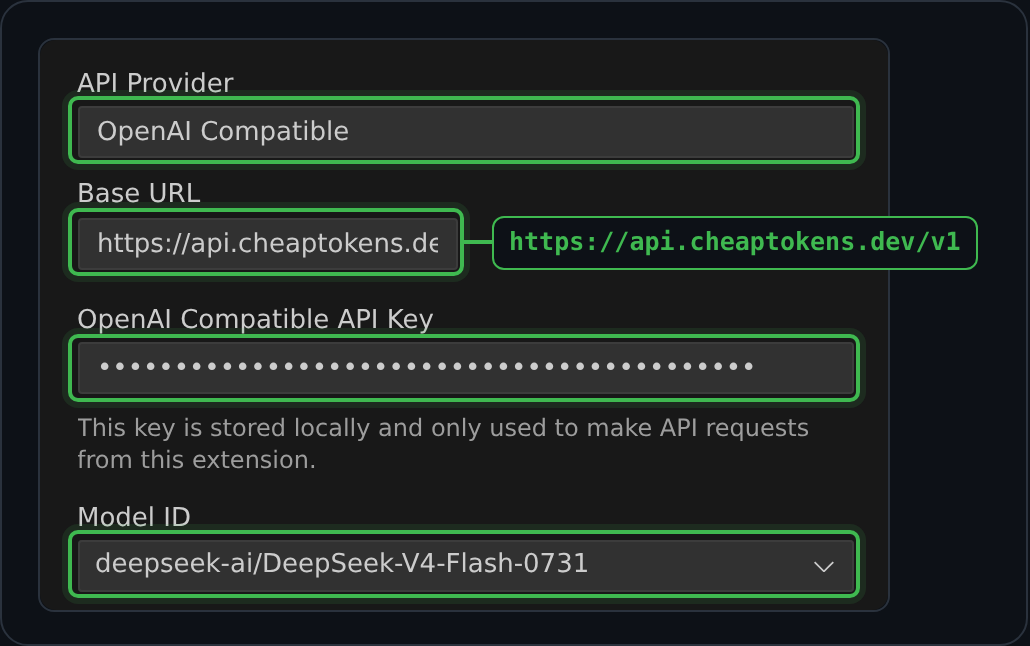
- Topic example: “A minimal coding agent on an OpenAI-compatible API with a budget limit”.
- Structure of the README: what it does → how to run it → which provider and model to set → what a typical run costs.
- Where the link goes: in the setup section of the README. Each user puts in their own API key — never share yours.
- What to measure: stars and forks as interest; sign-ups and top-ups from the README link as the result.
5. Answer questions in communities#
Threads where someone asks how to cut agent costs or which model to use with Cline are a natural place for a recommendation — when the answer actually helps.
- Topic example: a question like “Cline burns too much money with Claude — what is cheaper?”
- Answer structure: what affects the cost (input-heavy context, model choice) → one or two options with prices → how to switch.
- Where the link goes: at the end of the answer.
- What to measure: replies and clicks; sign-ups from each thread.
6. Pay for a placement#
Thematic Telegram channels, technical newsletters and authors of courses for developers can mention the service for a fee.
- Topic example: “How to cut the cost of an AI coding agent by changing the provider”.
- What to prepare: a ready demo (a short video or a guide), the text of the mention and your link with a separate campaign for this placement, so its results are visible separately.
- Where the link goes: next to the demo.
- What to measure: users who topped up and the reward for the period — see the next section.
How to measure the result#
Each channel goes through the same steps:
- A visit through your link.
- Sign-up — a new account.
- A top-up.
- The reward — your percentage of the top-up, on your partner balance after the hold.
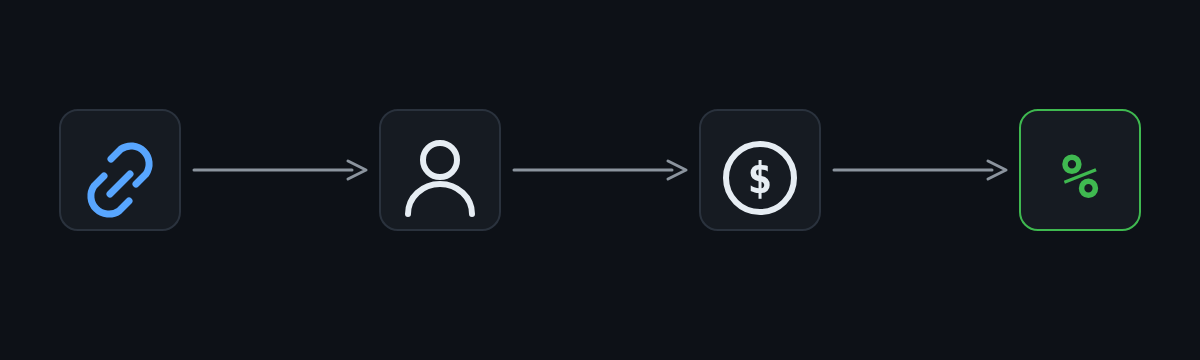
The Partner program tab shows clicks, sign-ups, paying referrals and rewards for each campaign, and every reward with its status and the date it becomes available. To compare channels, create a campaign for each one — your code and your main link stay the same.
The economics of a paid placement#
Compare what you spent on a placement with the reward for the same period. Example: a placement costs $50; the people it brought topped up $600 over a month; at 10% that is $60 of reward.
Terms in short#
The current percentage, the hold period, how the reward can be used and what the people you invite get are on the partner program page. The full rules are in the Partner Program Terms. Prices for requests are on the pricing page.


