Models & comparisonsComparison
GLM vs DeepSeek vs MiniMax: which model to choose
Context window, output limit, price per request and typical tasks for GLM-5.3-Flash, DeepSeek-V4-Flash and MiniMax-M2.7 — with the date and conditions of every calculation.
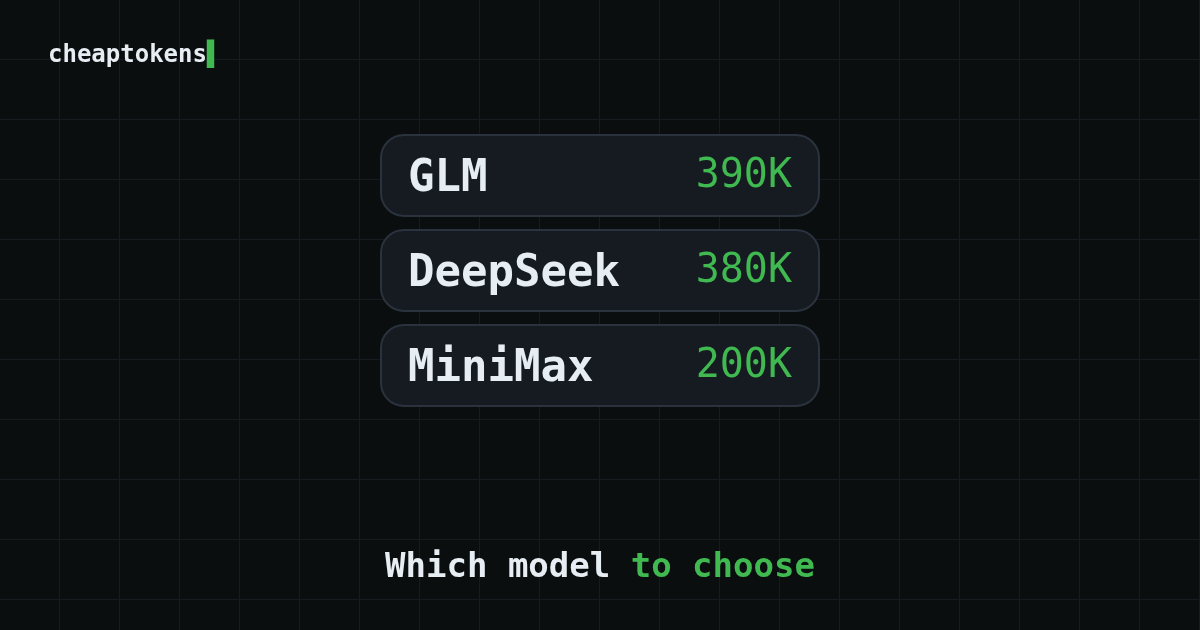
All three are open-weight models available through the same OpenAI-compatible API, with the same key. They differ in context size, output limit and price — and for most projects that is what decides. Limits below are as of October 20, 2026; prices and costs in the tables further down are live and always show current rates.
At a glance#
Scroll the table right →
| GLM-5.3-Flash | DeepSeek-V4-Flash | MiniMax-M2.7 | |
|---|---|---|---|
| API model ID | zai- |
deepseek- |
MiniMaxAI/ |
| Context window | 390K tokens | 380K tokens | 200K tokens |
| Max output | 8,192 tokens | 32,768 tokens | 8,192 tokens |
| Input | text | text | text |
| Typical tasks | complex coding and reasoning | everyday tasks on a budget | agents and workflow automation |
Limits come from GET https:/ — the same list your tools see.
Current prices (live)#
This table updates automatically: rates per million tokens, input and output separately — the same data as on the pricing page. OpenRouter figures are the list prices of the same models on openrouter.ai that we track for comparison.
| Model | Context | Input $/1M | Output $/1M | OpenRouter in | OpenRouter out |
|---|---|---|---|---|---|
| GLM-5.3-Flash reasoning temporarily unavailable | 390K | $0.027 | $0.08 | $0.048 | $0.20 |
| DeepSeek-V4-Flash temporarily unavailable | 380K | $0.0221 | $0.10 | $0.016 | $0.64 |
| MiniMax-M2.7 temporarily unavailable | 200K | $0.05 | $0.15 | $0.30 | $1.20 |
Prices in USD per 1M tokens. OpenRouter figures shown for comparison and may change.
Cost of a typical request#
Conditions: one request with 20,000 input tokens and 2,000 output tokens — a mid-sized coding question with a few files in context. The table is calculated from current prices and recalculates when they change; the OpenRouter column shows the same workload at the reference prices we track.
| Model | Input $/1M | Output $/1M | Per request | 1,000 requests | OpenRouter, 1,000 requests |
|---|---|---|---|---|---|
| GLM-5.3-Flash | $0.027 | $0.08 | $0.0007 | $0.70 | $1.36 |
| DeepSeek-V4-Flash | $0.0221 | $0.10 | $0.00064 | $0.642 | $1.60 |
| MiniMax-M2.7 | $0.05 | $0.15 | $0.0013 | $1.30 | $8.40 |
20,000 input and 2,000 output tokens per request. Prices per 1M tokens are current and change together with our tariffs; the OpenRouter column shows reference prices for the same workload.
How to choose#
These are starting points based on the limits and prices above — not benchmark results: we have not run quality tests of the three models.
- Long outputs — whole files, long reports, big refactors in one answer: DeepSeek-V4-Flash, the only one of the three with a 32K output limit.
- Lowest cost per request: see the table above — it is recalculated whenever prices change.
- Hard reasoning — multi-step changes, tricky bugs: GLM-5.3-Flash. It reasons before answering; the reasoning is generated text too, so it adds output tokens and time.
- Agents and automation: MiniMax-M2.7. Its context is the smallest of the three (200K), so trim long histories.
- Very long context — a large codebase or document set: GLM-5.3-Flash (390K) or DeepSeek-V4-Flash (380K).
The most reliable test is your own. A simple method: write down the model IDs and the date; take 10–20 real tasks from your work; run each through all three models with the same prompt; score correctness, how well instructions were followed, answer length and response time; read the token counts from usage and multiply them by the current rates.
Switching models#
The API, base URL and key are the same for all models — only the model field changes:
import os
from openai import OpenAI

client = OpenAI(base_url="https://api.cheaptokens.dev/v1", api_key=os.environ["CHEAPTOKENS_API_KEY"])

for model in ["zai-org/GLM-5.3-Flash", "deepseek-ai/DeepSeek-V4-Flash-0731", "MiniMaxAI/MiniMax-M2.7"]:
    resp = client.chat.completions.create(
        model=model,
        messages=[{"role": "user", "content": "Summarize the CAP theorem in two sentences."}],
    )
    print(model, resp.usage.prompt_tokens, resp.usage.completion_tokens)
    print(resp.choices[0].message.content, "\n")
The catalog changes over time: new models are added and some can be temporarily unavailable. Before hard-coding an ID, check GET /v1/models.


