Cost optimizationGuide
How much does Cline cost? A token budget for one session
Cline itself is free; the bill is the model's tokens. Estimate an evening session, split Plan and Act models, and keep the total down.
On this page
Cline costs nothing by itself; you pay for the tokens your model reads and writes. Per the Cline repository (checked 27 October 2026) the extension is Apache 2.0, and per its docs it works with your own provider credentials for cloud providers or local runtimes. So the real question is how many tokens one session burns, and which model burns them.
You ran Cline for an evening refactor, the agent kept reading files and editing, and now you wonder what that was worth. Let's put numbers on it.
Where the money goes in a Cline session#
Cline works in steps: read a file, propose an edit, run a command, look at the result. Every step is one API request. Per the Cline docs on Plan and Act, conversation history carries over between modes, and an API resends history with each request. That means step 30 is far heavier on input than step 3. The mechanism is explained in why a long chat costs more.
The pattern is simple: many steps, big input each time, short output. Input is the large side of the bill, the answer is the small one.
Cline's own provider is pay-as-you-go through credits, and a flat monthly plan exists too (see the Cline site for its current terms). With your own key there is no plan: you top up a balance and the session draws it down.
A budget for one evening#
Say you run a 40-step refactor. Assumption, not a measurement: about 30,000 input tokens and 1,500 output tokens per step. That is 40 × 30,000 = 1,200,000 input tokens and 40 × 1,500 = 60,000 output tokens for the session.
On DeepSeek-V4-Flash, the whole evening is $0.024. Here is the same session across our models, with input and output counted together and an OpenRouter column to compare against:
| Model | Input $/1M | Output $/1M | Per request | 40 requests | OpenRouter, 40 requests |
|---|---|---|---|---|---|
| GLM-5.3-Flash | $0.02 | $0.04 | $0.00066 | $0.0264 | $0.0541 |
| DeepSeek-V4-Flash | $0.015 | $0.10 | $0.0006 | $0.024 | $0.0664 |
| MiniMax-M2.7 | $0.05 | $0.15 | $0.0017 | $0.069 | $0.432 |
30,000 input and 1,500 output tokens per request. Prices per 1M tokens are current and change together with our tariffs; the OpenRouter column shows reference prices for the same workload.
In total, with input and output together, these prices sit below OpenRouter's. For a long agent session that is the number that matters. Your own step size will differ, so change the two numbers to match what you see in your sessions.
Quick check
Which side of a Cline session is usually bigger?
Show answer
Answer: Input: history and files resent on every step
Input grows with every step because the history is resent, while each answer stays short.
Plan with one model, act with another#
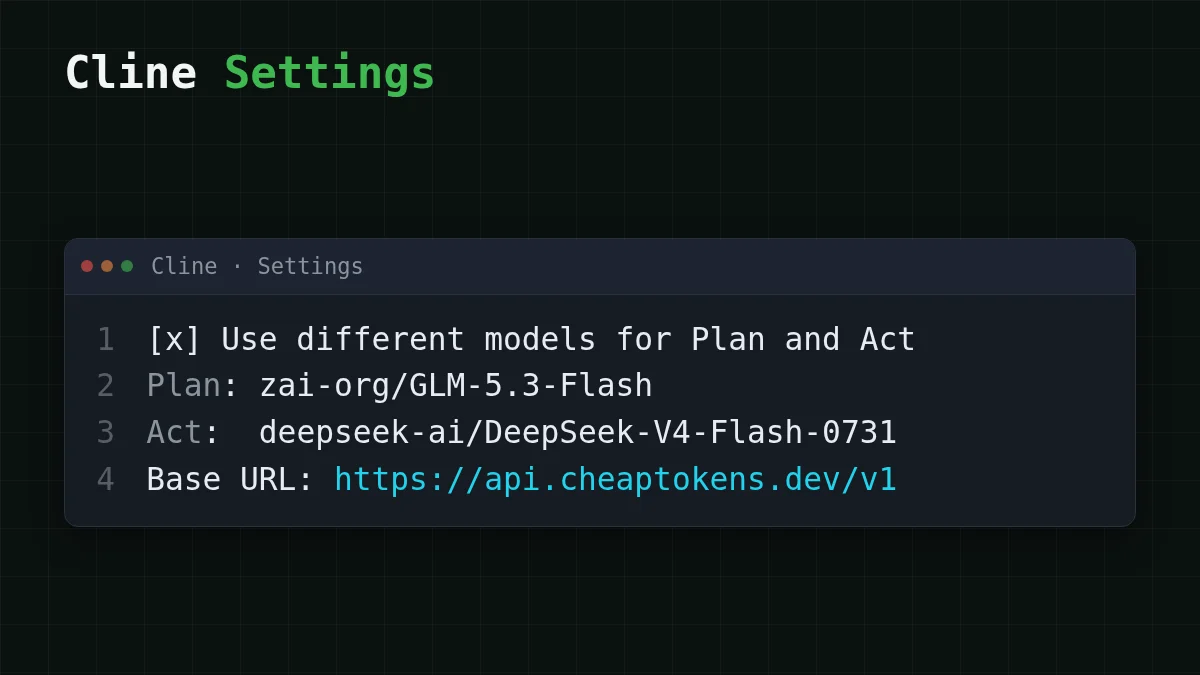
Plan mode cannot modify files or run commands; Act mode can (Cline docs, checked 27 October 2026). In Settings there is a switch, "Use different models for Plan and Act". The docs themselves show a cost-optimization pairing of GLM 4.6 for Plan and Grok Code Fast for Act, without giving figures, so treat it as an idea and not a proven saving.
On CheapTokens the split could look like this:
- Plan:
zai-, 390K context to hold a big repo while it reasons about the change.org/ GLM- 5. 3- Flash - Act:
deepseek-, 380K context and up to 32,768 output tokens per answer, with one price at any hour of the day.ai/ DeepSeek- V4- Flash- 0731 - Base URL for both:
https:/. Setup steps are in how to connect Cline to CheapTokens./ api. cheaptokens. dev/ v1
Same evening, split. Assume 6 planning steps and 34 acting steps, same size as above. Planning is 6 × 30,000 = 180,000 input and 6 × 1,500 = 9,000 output on GLM-5.3-Flash: $0.004. Acting is 34 × 30,000 = 1,020,000 input and 34 × 1,500 = 51,000 output on DeepSeek-V4-Flash: $0.0204.
The point is not the pennies. It is that the planning model only has to be good at thinking, and the model doing 34 repetitive edits only has to be steady and cheap. MiniMax-M2.7 (180K context) is another candidate for the Act loop.
Plan first, so Act does not wander#
The Cline docs suggest Act alone for small tasks, Plan then Act for medium ones, and /deep-planning for large ones. A vague Act request is where the bill balloons: the agent explores, edits, undoes. A reviewed plan turns that into a short list of steps.
Put the order of a cheap session together:
Put in order
Put the session in a cheap order
Drag the items or use the arrows
- Describe the task in Plan mode and read the plan
- Correct the plan until it names the files to touch
- Switch to Act and approve edits one by one
- Start a fresh task when the topic changes
Approval matters too. Every file edit and terminal command needs your OK unless auto-approve is on, and checkpoints track changes. Leaving approval on for the first minutes is the cheapest insurance: you stop a wrong direction after one step, not after thirty.
Keep the budget honest#
Start small. Run one real task, note how many steps it took, then multiply. Cline's docs say usage is visible in Settings, View Usage, for its own provider; with your own key, the balance in your CheapTokens account shows what the session actually used. Compare it with the estimate above and adjust the two numbers.
Prices are on the pricing page, the docs cover the API, and the DeepSeek page lists what DeepSeek-V4-Flash supports. If you also use Aider, its cost guide works the same way.


