AI newsUpdate
Mistral Large 4 open weights: API price and cost per agent task
Mistral Large 4 is now open-weight, with API pricing from Mistral. See what one coding-agent task costs and when a cheaper model fits.
On this page
Mistral Large 4 is now open-weight: Mistral published the weights on 29 October 2026 and set the API price at $0.70 per 1M input tokens and $2.10 per 1M output tokens ($0.07 for cached input). If you run coding agents, the useful question is not the price per token but what one long task adds up to.
What Mistral announced#
According to Mistral's release page (checked 30 October 2026), Mistral Large 4 is a model of about 1T parameters, a hybrid of instruct and reasoning built as a mixture of experts. It is natively multimodal on input, covers 160+ languages and has three reasoning modes, Low, Medium and High, with High as the default. The Hugging Face repository is Mistral-; the API id is mistral-.
The weights ship under the Mistral Ecosystem Open-Weight license, a modified MIT. Commercial use and fine-tuning are allowed. Selling the model as a hosted service needs a separate commercial license from Mistral. You can run it with vLLM or SGLang, through NVIDIA NIM or TensorRT-LLM, or use Mistral's own API, Microsoft Foundry and Mistral Vibe Code.
On benchmarks Mistral reports its own numbers: 41% on Terminal-Bench 4.0 (the preview scored 28%), 19.7% on FrontierCode 2.0, 84.5% on BrowseComp, and 48% on the Artificial Analysis Coding Agent Index, which Mistral says is level with GLM-5.3 at 47% fewer tokens per task. These are the vendor's results, not independent ones, so treat them as a reason to test on your own repo rather than a verdict.
What one agent task costs at Mistral's price#
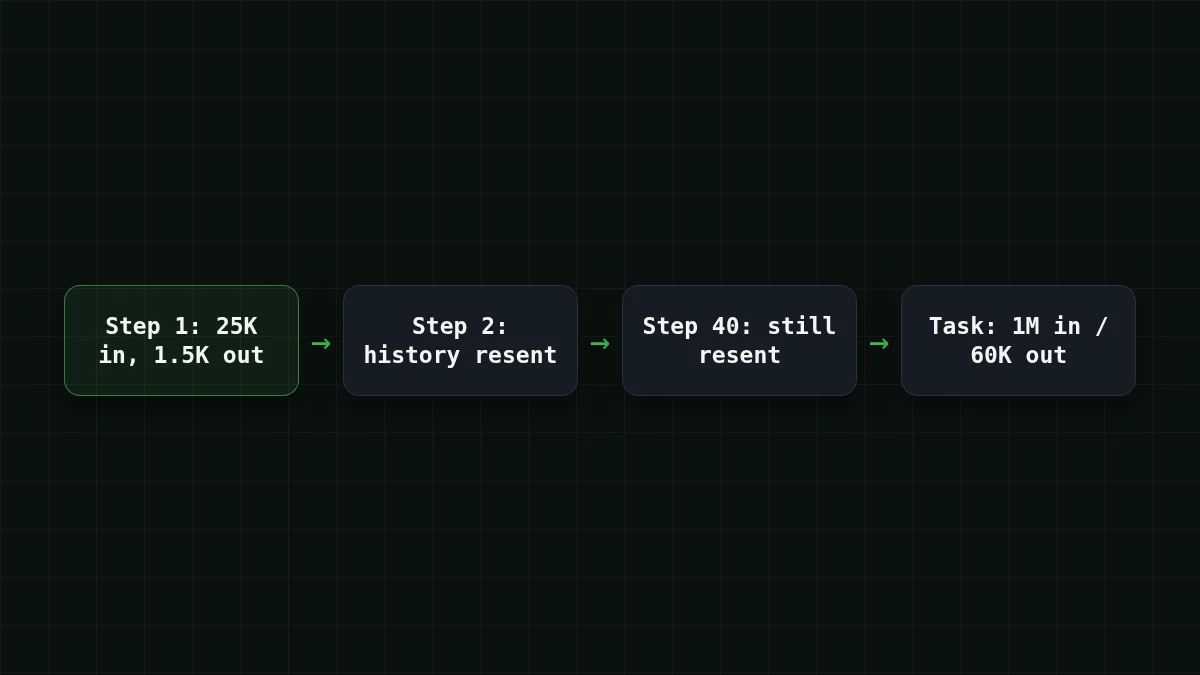
Start with how an agent really spends tokens. Every step resends the conversation so far, so input piles up while each answer stays short. Say a terminal coding agent takes 40 steps on one task, with about 25,000 input tokens and 1,500 output tokens per step. That is an assumption for illustration; swap in your own numbers.
Guess the number
40 steps at about 25,000 input tokens each: how many thousand input tokens does the task send in total?
Your guess
02,000
Show answer
Answer: 1,000
25,000 × 40 = 1,000,000 input tokens, so 1,000 thousand. The agent resends its context on every step, which is why input volume dominates agent bills.
At Mistral's published price (30 October 2026) that task is 1,000,000 × $0.70 / 1M = $0.70 for input and 60,000 × $2.10 / 1M = $0.126 for output, so $0.70 + $0.126 = $0.826 per task. The input side is most of the bill.
Caching changes the picture. If 20,000 of the 25,000 input tokens in each step are served from cache at $0.07 per 1M, a step costs 20,000 × $0.07 / 1M = $0.0014 for cached input, 5,000 × $0.70 / 1M = $0.0035 for fresh input and 1,500 × $2.10 / 1M = $0.00315 for output. That is $0.00805 a step, and $0.00805 × 40 = $0.322 per task. The 80% cache hit rate is another assumption, so check what your tool reports.
Here is the same workload on a calculator you can move:
Cost calculator
One coding-agent task: 40 steps
Input tokens per request: 25,000 · Output tokens per request: 1,500 · Requests per day: 40
| Model | Per day | Per month |
|---|---|---|
| GLM-5.3-Flash$0.02$0.04 | $0.0224 | $0.672 |
| DeepSeek-V4-Flash$0.015$0.10 | $0.021 | $0.63 |
| MiniMax-M2.7$0.05$0.15 | $0.059 | $1.77 |
And the same task priced across CheapTokens models, live, next to OpenRouter:
| Model | Input $/1M | Output $/1M | Per request | 40 requests | OpenRouter, 40 requests |
|---|---|---|---|---|---|
| GLM-5.3-Flash | $0.02 | $0.04 | $0.00056 | $0.0224 | $0.0458 |
| DeepSeek-V4-Flash | $0.015 | $0.10 | $0.00053 | $0.021 | $0.0569 |
| MiniMax-M2.7 | $0.05 | $0.15 | $0.0015 | $0.059 | $0.372 |
25,000 input and 1,500 output tokens per request. Prices per 1M tokens are current and change together with our tariffs; the OpenRouter column shows reference prices for the same workload.
For this agent loop, DeepSeek-V4-Flash on CheapTokens comes to $0.021 for the whole task, in total with input and output counted together, and it is cheaper than OpenRouter's reference price in total. It has a 380K context window and up to 32,768 output tokens per answer, at one price at any hour of the day.
Open weights or the API#
The weights are the interesting part of this release. If your data cannot leave your network, or you want to fine-tune, you can now do that with a model of this class. The cost of that route is hardware. A 1T-parameter model needs a multi-GPU server even if only a part of it is active per token, and Mistral's page does not state the active parameter count (the A52B in the repository name suggests 52B, but that is an inference from the name). Mistral's page does not state the context size either.
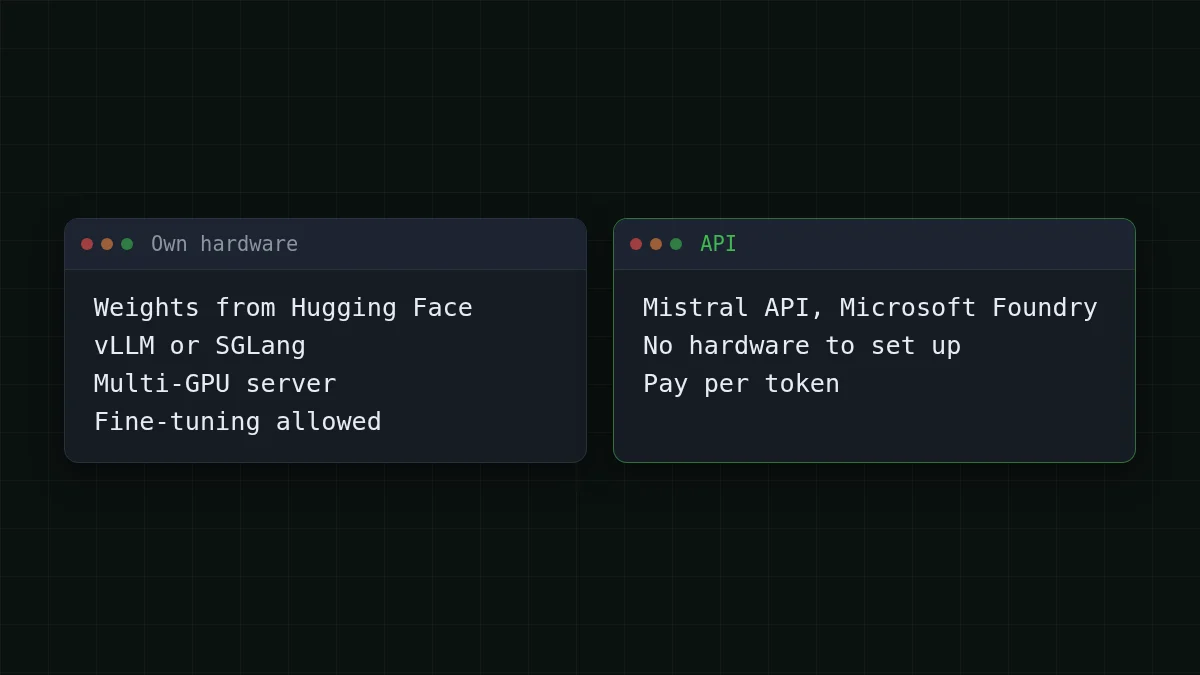
For most teams that just want an agent to finish tickets, the API route avoids that setup. If you want the background on what open weights mean in practice, see what open weights and quantization are.
Same task on an agent model you can call today#
If your goal is a terminal or IDE agent that runs many steps cheaply, you can try the same loop on DeepSeek-V4-Flash or GLM-5.3-Flash through CheapTokens. The API is OpenAI Chat Completions and Anthropic Messages compatible, with one balance for all models. Use the full model id from the CheapTokens docs; model names differ between providers.
One request, two clients
curl
curl https://api.cheaptokens.dev/v1/chat/completions \
  -H "Authorization: Bearer $CHEAPTOKENS_API_KEY" \
  -H "Content-Type: application/json" \
  -d '{"model": "deepseek-ai/DeepSeek-V4-Flash-0731", "messages": [{"role": "user", "content": "Find the bug in this stack trace and propose a fix."}], "max_tokens": 1500}'
Python
from openai import OpenAI

client = OpenAI(base_url="https://api.cheaptokens.dev/v1", api_key="YOUR_CHEAPTOKENS_KEY")
resp = client.chat.completions.create(
    model="deepseek-ai/DeepSeek-V4-Flash-0731",
    messages=[{"role": "user", "content": "Find the bug in this stack trace and propose a fix."}],
    max_tokens=1500,
)
print(resp.choices[0].message.content)
print(resp.usage)
The usage field in the response shows input and output tokens, so you can measure your own agent's step and plug it into the calculator above. Our Cline cost guide shows how to budget a whole session, and the docs cover connecting other tools. Model pages: cheap DeepSeek, and live pricing.
Which one for which job#
Open weights on your own hardware, and fine-tuning, are a separate path, and that is what this release opens up. For a long loop of short steps, use DeepSeek-V4-Flash on CheapTokens: 380K context, up to 32,768 output tokens per answer, one price at any hour of the day, and cheaper than OpenRouter in total, with input and output counted together. GLM-5.3-Flash has a 390K context. Mistral's benchmark compares against GLM-5.3, and it does not say which GLM-5.3 variant, so do not read its numbers onto GLM-5.3-Flash. Run ten of your own tasks on each and compare the token counts; the same approach is in how the GPT-6.1 Terra price works out per task.


