AI newsUpdate
GPT-6.1 Terra API price: $1 in, $5 out per 1M tokens
What OpenAI's new GPT-6.1 Terra price means for a 20-step agent task, next to the old GPT-5.6 Terra price and cheaper models.
On this page
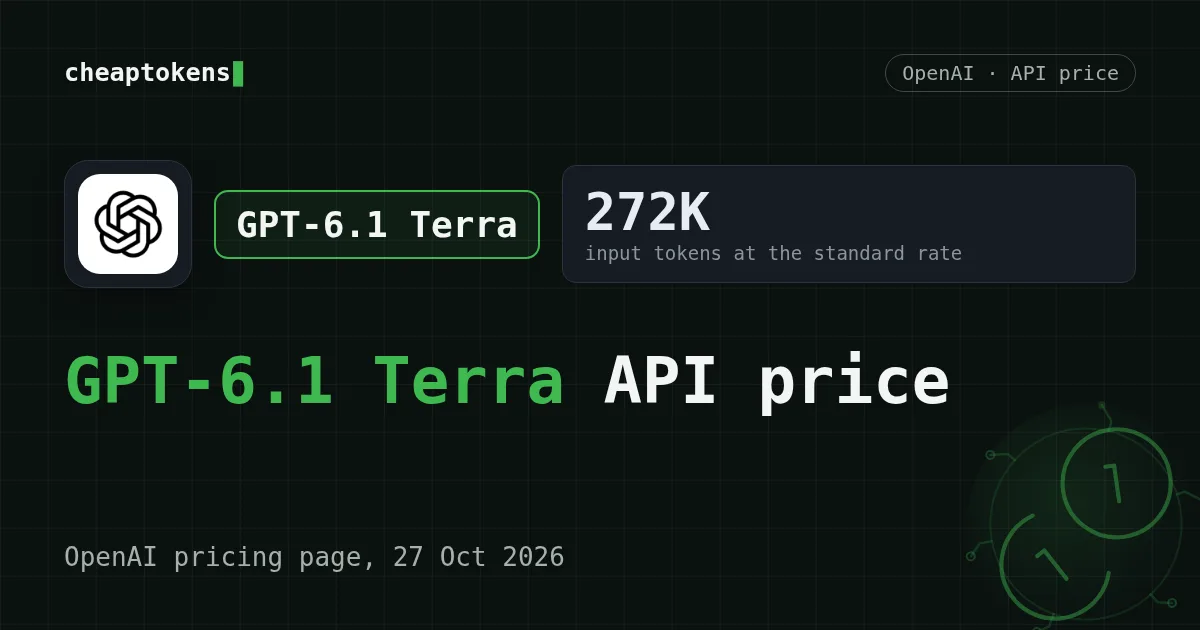
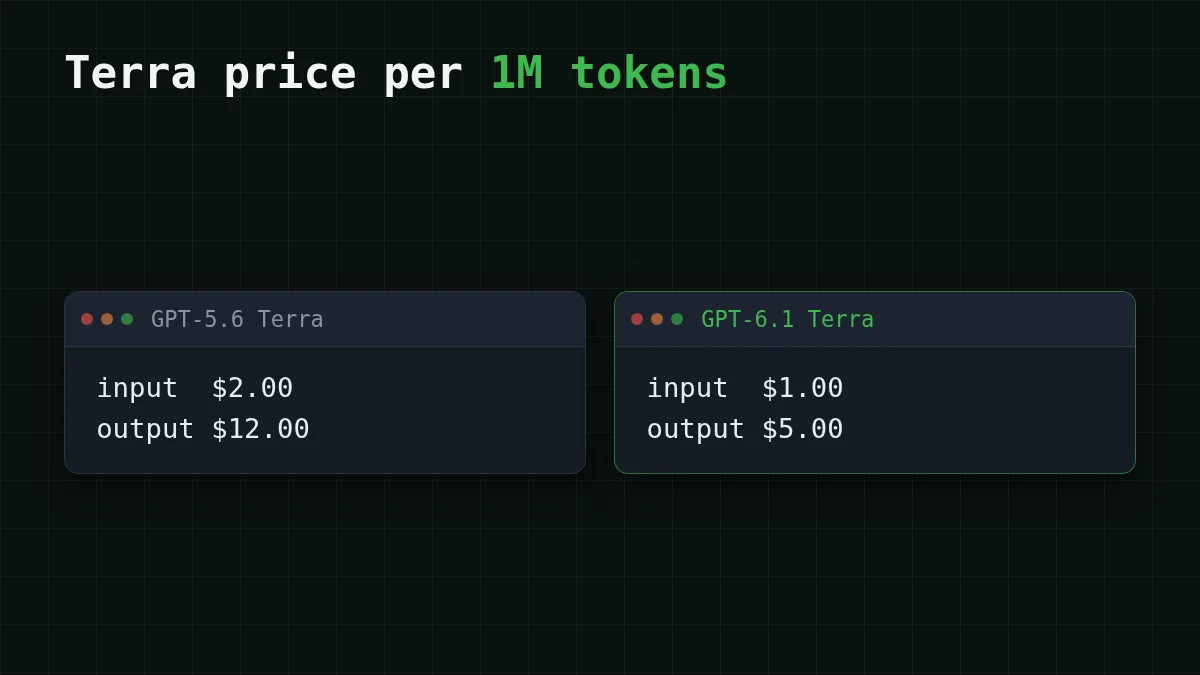
GPT-6.1 Terra is listed at $1.00 per 1M input tokens and $5.00 per 1M output tokens on OpenAI's API pricing page (checked 27 October 2026). The previous Terra, GPT-5.6 Terra, is listed on the same page at $2.00 and $12.00. If your coding agent runs on GPT-5.6 Terra, moving it to GPT-6.1 Terra roughly halves the bill for the same task. Below: by how much for a typical agent task, and where a cheaper model gets you further.
What changed on the price page#
GPT-6.1 Terra is listed on OpenAI's pricing page (checked 27 October 2026) with the API id gpt-6.1-terra. Input dropped to half of the old price. Output went from $12.00 to $5.00. That second number matters more than it looks: agents write a lot, and output is the expensive side.
The page has more than one row, though, and picking the wrong one is the easiest way to be surprised by an invoice:
Match the pairs
Match each tier on the price page to its rates
Tap an item on the left, then its pair
- Standard, input up to 272K tokens$1.00 in, $5.00 out per 1M
- Input above 272K tokens$2.00 in, $7.50 out per 1M
- Batch / Flex$0.50 in, $2.50 out per 1M
- Fast$2.00 in, $10.00 out per 1M
Cached input is listed separately at $0.05 per 1M on the standard tier, which helps when every step of an agent re-sends the same long prefix. The rest of this article uses the standard tier and no caching, so the numbers are easy to redo.
What a 20-step agent task costs#
Say your agent solves one ticket in 20 steps. Each step sends the task, the files it has opened and the tool results so far, about 30,000 input tokens on average, and writes about 1,500 tokens back (a plan, a patch, a command). That is a plain-looking assumption, and it is the one that makes agents expensive: the input is re-sent every step. (If that part is new, why AI agents use so many tokens walks through it.)
One task then adds up to 20 × 30,000 = 600,000 input tokens and 20 × 1,500 = 30,000 output tokens. Every step stays far below the 272K line, so the standard rates apply.
- GPT-6.1 Terra: 0.6 × $1.00 = $0.60 for input, 0.03 × $5.00 = $0.15 for output, $0.60 + $0.15 = $0.75 per task.
- GPT-5.6 Terra: 0.6 × $2.00 = $1.20 for input, 0.03 × $12.00 = $0.36 for output, $1.20 + $0.36 = $1.56 per task.
Now scale it. A team that closes 100 such tasks a day pays 100 × $0.75 = $75 a day on the new model against 100 × $1.56 = $156 on the old one. A real cut, and no change to your code except the model id.
The same task on the models we serve, at live prices (one step is 30,000 in and 1,500 out, times 20 steps):
| Model | Input $/1M | Output $/1M | Per request | 20 requests | OpenRouter, 20 requests |
|---|---|---|---|---|---|
| GLM-5.3-Flash | $0.02 | $0.04 | $0.00066 | $0.0132 | $0.0271 |
| DeepSeek-V4-Flash | $0.015 | $0.10 | $0.0006 | $0.012 | $0.0332 |
| MiniMax-M2.7 | $0.05 | $0.15 | $0.0017 | $0.0345 | $0.216 |
30,000 input and 1,500 output tokens per request. Prices per 1M tokens are current and change together with our tariffs; the OpenRouter column shows reference prices for the same workload.
For one whole task, DeepSeek-V4-Flash comes to $0.012, GLM-5.3-Flash to $0.0132 and MiniMax-M2.7 to $0.0345. The table also shows the OpenRouter price for each of them, and in total, with input and output counted together, CheapTokens is the cheaper side.
Before you move a whole pipeline, send a handful of your own tickets to the candidate model and compare the token counts in the usage block with the table above.
Which model for which job#
If the price drop pulled you toward Terra, ask first what your loop actually needs. Long histories, long answers, a tight budget: those are three different jobs, and we have a model for each.
Pick your case
Pick the job closest to yours
Choose an option to see the answer
A long coding-agent loop
Take DeepSeek-V4-Flash. It has a 380K context, writes up to 32,768 output tokens per answer, and costs the same at any hour of the day. That suits agents that read many files and then write big patches.
Everyday coding and chat
Take GLM-5.3-Flash. It has a 390K context and answers up to 8,192 tokens, and in total it is cheaper than OpenRouter for the same tokens.
Agent work on a tight budget
Take MiniMax-M2.7. It has a 180K context and answers up to 8,192 tokens, and in total it is cheaper than OpenRouter for the same tokens.
All three sit behind one balance and speak both the OpenAI and the Anthropic API, so switching between them is a one-line change of the model id.
Try it on your own task#
Send one of your real prompts to a cheaper model and read the usage block in the answer. It tells you the exact input and output tokens, which you can compare with the 30,000-in / 1,500-out step assumed above. Example request (the address and model id are the ones to copy; keep your key in an environment variable):
curl https://api.cheaptokens.dev/v1/chat/completions \
  -H "Authorization: Bearer $CHEAPTOKENS_API_KEY" \
  -H "Content-Type: application/json" \
  -d '{
    "model": "deepseek-ai/DeepSeek-V4-Flash-0731",
    "messages": [{"role": "user", "content": "Write a unit test for a function that parses ISO dates."}],
    "max_tokens": 800
  }'
The full setup is in the CheapTokens docs, the live price list is on the pricing page, and how to estimate the cost of an AI agent shows how to turn your own logs into the two numbers this article started from.


