Models & comparisonsComparison
Cheapest DeepSeek API model in 2026: deepseek-flash vs Pro
Official DeepSeek API prices checked 29 Oct 2026: Flash vs Pro, peak vs off-peak, cache hits, and what a support bot and an agent really cost.
On this page
Your DeepSeek bill depends on three things the price per token doesn't show: which model you call, what hour you call it, and how much of your prompt the cache remembers. The short answer: of the two official models, deepseek-flash is the cheaper one in every column. Off-peak it costs $0.15 per 1M input tokens (cache miss) and $0.60 per 1M output tokens. At peak, both double.
The prices below come from DeepSeek's pricing page, fetched on 29 October 2026. The page carries no publication date, so treat the fetch date as the price date.
Two official models, one rename#
The official API sells two models: deepseek-flash, served by DeepSeek-V4.1-Flash-1017, and deepseek-v4-pro, served by DeepSeek-V4-Pro-0813. Both list a 1M context and up to 384K tokens of output.
If your code still says deepseek- or deepseek-, nothing breaks. DeepSeek's 17 October 2026 release note says those models are retired and their names now route to DeepSeek-V4.1-Flash-1017 at the Flash price. What changed inside the model is covered in the write-up of the release.
Here are the prices per 1M tokens, in USD:
Scroll the table right →
| Per 1M tokens | Flash, off-peak | Flash, peak | Pro, off-peak | Pro, peak |
|---|---|---|---|---|
| Input, cache hit | $0.003 | $0.006 | $0.022 | $0.044 |
| Input, cache miss | $0.15 | $0.30 | $0.66 | $1.32 |
| Output | $0.60 | $1.20 | $1.98 | $3.96 |
"Cache hit" means DeepSeek recognises the beginning of your prompt from an earlier request and bills that part at the cheap rate. Prompt caching explained has the mechanics. Everything that isn't a hit is a miss.
Peak hours: same request, double the price#
Peak is 01:00–04:00 and 06:00–10:00 UTC, Monday to Friday, except Chinese public holidays. Outside those windows you pay the off-peak price, which is half.
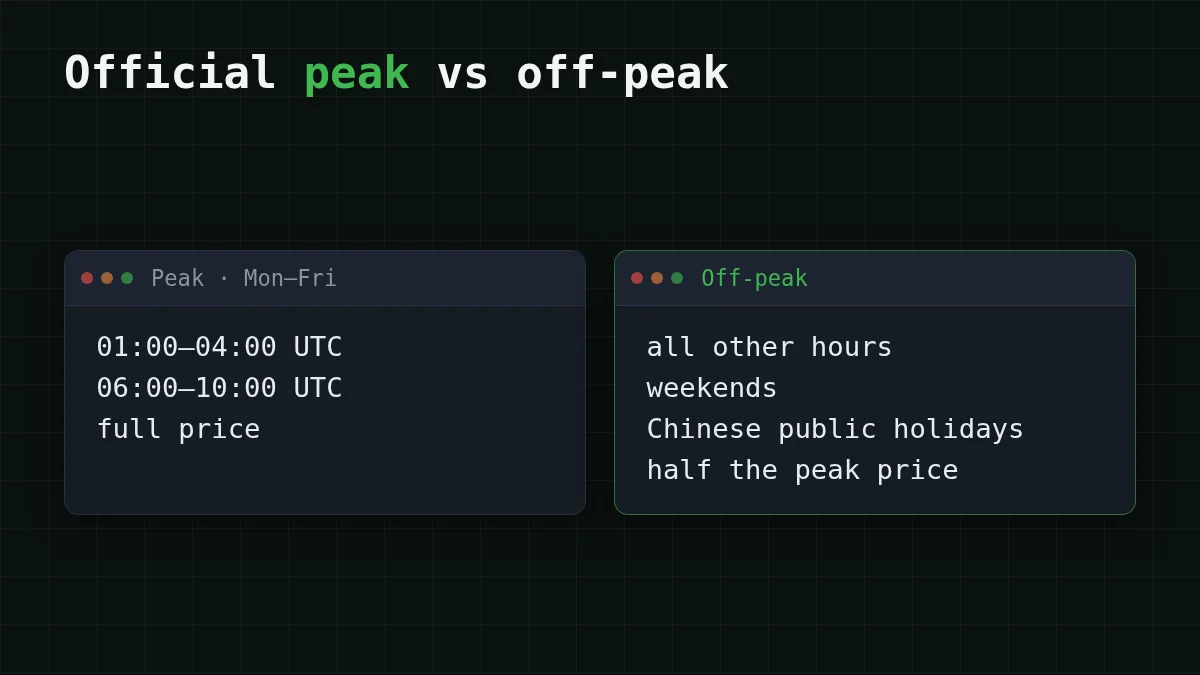
Seven hours a day sounds like little. It is: 7 × 5 = 35 of the week's 168 hours, about a fifth. But those windows cover most of the Beijing working day and the European morning, so a bot that talks to people in those time zones lives inside them. A job that runs at 22:00 UTC never sees peak pricing.
Guess the number
How many hours of a weekday fall inside the official peak windows?
Your guess
024
Show answer
Answer: 7
Seven: 01:00–04:00 is 3 hours and 06:00–10:00 is 4 hours, and 3 + 4 = 7.
A support bot: 1,000 requests a day#
Say you run a support bot. Each request carries about 1,500 input tokens (the instructions plus the customer's message) and gets back about 400 tokens. That's 1.5M input and 0.4M output tokens a day, and for simplicity none of it hits the cache.
On deepseek-flash at peak, input is 1.5 × $0.30 = $0.45. Output is 0.4 × $1.20 = $0.48. A day comes to $0.45 + $0.48 = $0.93. Off-peak, input is 1.5 × $0.15 = $0.225 and output is 0.4 × $0.60 = $0.24, so a day is $0.225 + $0.24 = $0.465.
On deepseek-v4-pro at peak, input is 1.5 × $1.32 = $1.98. Output is 0.4 × $3.96 = $1.584. A day comes to $1.98 + $1.584 = $3.564.
Look at where the money goes. On Flash the 400-token answers cost slightly more than the 1,500-token prompts, because output is the expensive side. And Pro is the model you pick after a test on your own tickets shows Flash's answers falling short, not before: that test is worth $3.564 a day at peak.
An agent loop: where the cache pays#
A coding agent is the opposite of a chatbot. Every step re-sends the same big prefix: instructions, tool definitions, the files it has already read. Say a run is 100 steps with 30,000 input tokens and 2,000 output tokens each, and 80% of every prompt is that repeated prefix. That's 3M input tokens (2.4M hits, 0.6M misses) and 0.2M output tokens.
On deepseek-flash at peak, with no cache at all: 3 × $0.30 = $0.90 for input plus 0.2 × $1.20 = $0.24 for output, $0.90 + $0.24 = $1.14.
With the 80% hit rate: 2.4 × $0.006 = $0.0144 for the hits, 0.6 × $0.30 = $0.18 for the misses, and the same $0.24 for output, $0.0144 + $0.18 + $0.24 = $0.4344.
The cache took input from $0.90 to $0.1944 and made output the biggest line on the bill. That's the pattern with agents: once the prefix is cached, the answers cost more than the reading. Keep the start of your prompt identical from step to step, and put what changes at the end.
Change the numbers to your own loop:
Cost calculator
A coding agent: 100 steps
Input tokens per request: 30,000 · Output tokens per request: 2,000 · Requests per day: 100
| Model | Per day | Per month |
|---|---|---|
| GLM-5.3-Flash$0.02$0.04 | $0.068 | $2.04 |
| DeepSeek-V4-Flash$0.015$0.10 | $0.065 | $1.95 |
| MiniMax-M2.7$0.05$0.15 | $0.18 | $5.40 |
The calculator uses live prices, so it moves when the price list does. Official figures above stay as of 29 October 2026.
Which setup fits your job#
Pick your case
Pick the closest job
Choose an option to see the answer
Support bot, traffic all day
Traffic doesn't wait for off-peak. Officially, deepseek-flash at peak is the number to plan with: $0.30 input and $1.20 output per 1M tokens. A single price at every hour, like DeepSeek-V4-Flash on CheapTokens, makes the monthly bill easy to predict.
Overnight batch job
Move the schedule outside 01:00–04:00 and 06:00–10:00 UTC and the official off-peak price applies, half of peak. If the job can't move, the peak price is the real one.
Agent with a big repeated prompt
Keep the prompt prefix stable so the cache hit rate stays high, and expect output to become the largest part of the bill. A flat price with no peak windows makes a loop like this easy to budget.
Flash isn't good enough
Test deepseek-v4-pro on a sample of your own tasks first. Its cache-miss input is $1.32 at peak and its output is $3.96, so it should earn that price on your data.
The same loads on CheapTokens#
For the support bot and the agent loop, CheapTokens has DeepSeek-V4-Flash: id deepseek-, 380K context, up to 32,768 output tokens per answer. It's one price at any hour, with no peak windows, one balance for all models, and an OpenAI- and Anthropic-compatible API at https:/. In total, with input and output counted together, it is cheaper than OpenRouter.
One support-bot request (1,500 in, 400 out) costs $0.000063. The 100-step agent run above (3M in, 0.2M out) costs $0.065. The table below is the bot's day, 1,000 requests, across all our models with the OpenRouter column next to them; set it beside the official figures above:
| Model | Input $/1M | Output $/1M | Per request | 1,000 requests | OpenRouter, 1,000 requests |
|---|---|---|---|---|---|
| GLM-5.3-Flash | $0.02 | $0.04 | $0.000046 | $0.046 | $0.0923 |
| DeepSeek-V4-Flash | $0.015 | $0.10 | $0.000063 | $0.0625 | $0.134 |
| MiniMax-M2.7 | $0.05 | $0.15 | $0.00014 | $0.135 | $0.93 |
1,500 input and 400 output tokens per request. Prices per 1M tokens are current and change together with our tariffs; the OpenRouter column shows reference prices for the same workload.
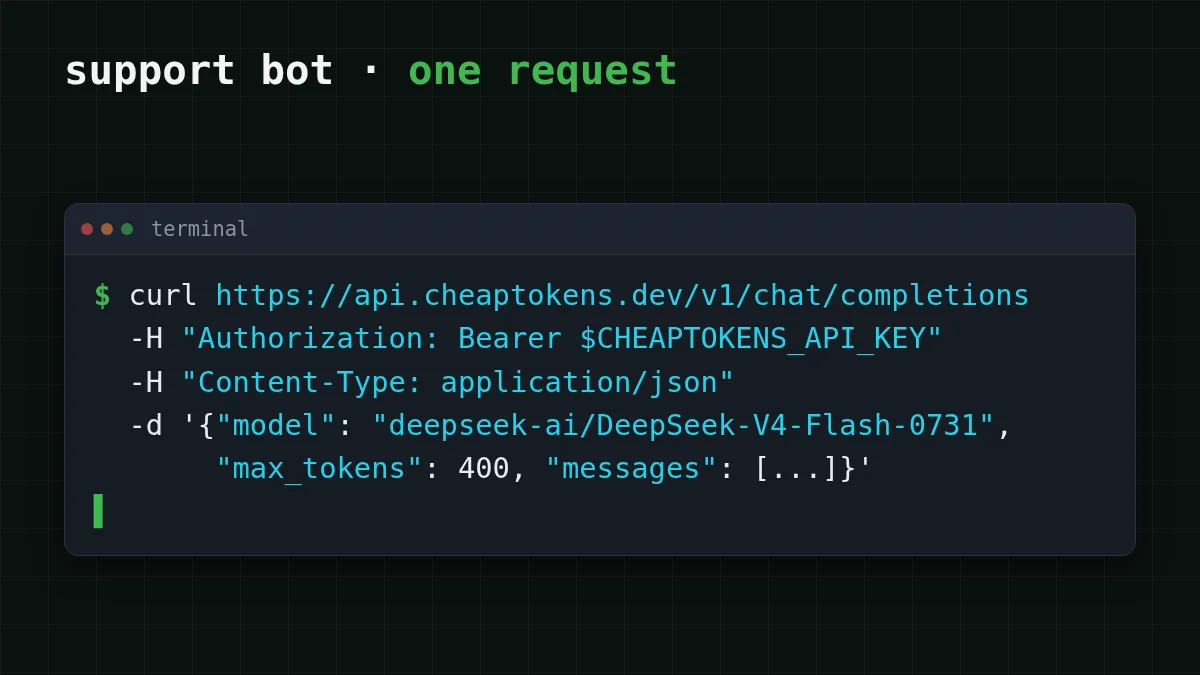
To send the bot's request yourself (use the id exactly as written; short ids from price labels aren't accepted):
curl https://api.cheaptokens.dev/v1/chat/completions \
  -H "Authorization: Bearer $CHEAPTOKENS_API_KEY" \
  -H "Content-Type: application/json" \
  -d '{
    "model": "deepseek-ai/DeepSeek-V4-Flash-0731",
    "max_tokens": 400,
    "messages": [{"role": "user", "content": "Where is my order #1042?"}]
  }'
The response has a usage block with the real input and output token counts. Multiply them by the live prices, or paste them into the table above, and you have the cost of your own request instead of a guess.
For the connection details see the CheapTokens docs, the DeepSeek page and the live pricing table. If you're weighing DeepSeek against another family, MiniMax-M2.7 vs DeepSeek-V4-Flash puts them side by side on the same tasks.


