Models & comparisonsComparison
Cheapest Gemini API model in 2026: Flash-Lite prices compared
Which Gemini model has the lowest paid price, which have a free tier, what doubles on 1 Dec and 1 Jan, and what 1,000 requests cost next to CheapTokens models.
On this page
You want the cheapest Gemini model, and Google's price list has more rows than you have patience for. Here is the short version. On the Gemini API pricing page (updated 27 October 2026, checked 29 October), Gemini 2.5 Flash-Lite (gemini-) has the lowest paid text price: $0.10 per 1M input tokens and $0.40 per 1M output tokens. It also has a free tier, like Gemini 3.1 Flash-Lite, Gemini 3.5 Flash-Lite and Gemini 2.5 Flash. And two price rises are already on the page: Gemini 4 Argon doubles on 1 December 2026, Gemini 3.8 Flash and 3.6 Flash double on 1 January 2027.
Below: the prices side by side, what changes and when, and what 1,000 ordinary requests cost on Gemini versus the models you can call through CheapTokens. For the exact mechanics of billing, input vs output tokens is the short explainer.
Gemini prices today, per 1M tokens#
These are standard paid-tier text prices from Google's pricing page, as of 29 October 2026.
Scroll the table right →
| Model | Input | Output | Free tier |
|---|---|---|---|
| Gemini 2.5 Flash-Lite | $0.10 | $0.40 | yes |
| Gemini 3.1 Flash-Lite | $0.25 | $1.50 | yes |
| Gemini 3.5 Flash-Lite | $0.30 | $2.50 | yes |
| Gemini 2.5 Flash | $0.30 | $2.50 | yes |
| Gemini 4 Argon | $2.00 | $10.00 | no |
A few things hide in the footnotes. Audio input costs more on the Flash-Lite models ($0.30 on 2.5 Flash-Lite, $0.50 on 3.1 Flash-Lite), so a voice pipeline will not match this table. The Batch API takes 50% off, but it is asynchronous: you submit a job and collect results later, so it suits overnight jobs, not a chat window. And the output column is headed Output (incl. thinking), which matters more than it looks. More on that in a minute.
Gemini 3.1 Pro Preview sits higher at $2.00 / $12.00 for prompts up to 200k tokens and $4.00 / $18.00 above that. Only it and Gemini 2.5 Pro have that 200k split.
Which prices double, and when#
If you prototype on a free tier, plan for the paid price from day one, and keep these dates in mind. Our separate piece on Gemini 4 Argon pricing covers that model in detail.
Timeline
Gemini price changes already on Google's page
- 27 Oct 2026pricing page last updated; Gemini 2.5 Flash-Lite is the lowest paid text price
- 1 Dec 2026Gemini 4 Argon goes from $2.00 / $10.00 to $4.00 / $20.00 per 1M tokens
- 1 Jan 2027Gemini 3.8 Flash and Gemini 3.6 Flash go from $0.75 / $3.75 to $1.50 / $7.50 per 1M tokens
Notice what is not on that list: the three Flash-Lite models. Their prices stay as in the table. Gemini 3.6 Flash is labelled previous generation on the page, so if you are choosing a new Flash model today, the rise is one more reason to look at the cheaper rows instead.
The pricing page gives no shutdown date for gemini-. Before you build a year-long product on the cheapest row, open Google's deprecations page and look for one.
What 1,000 requests cost#
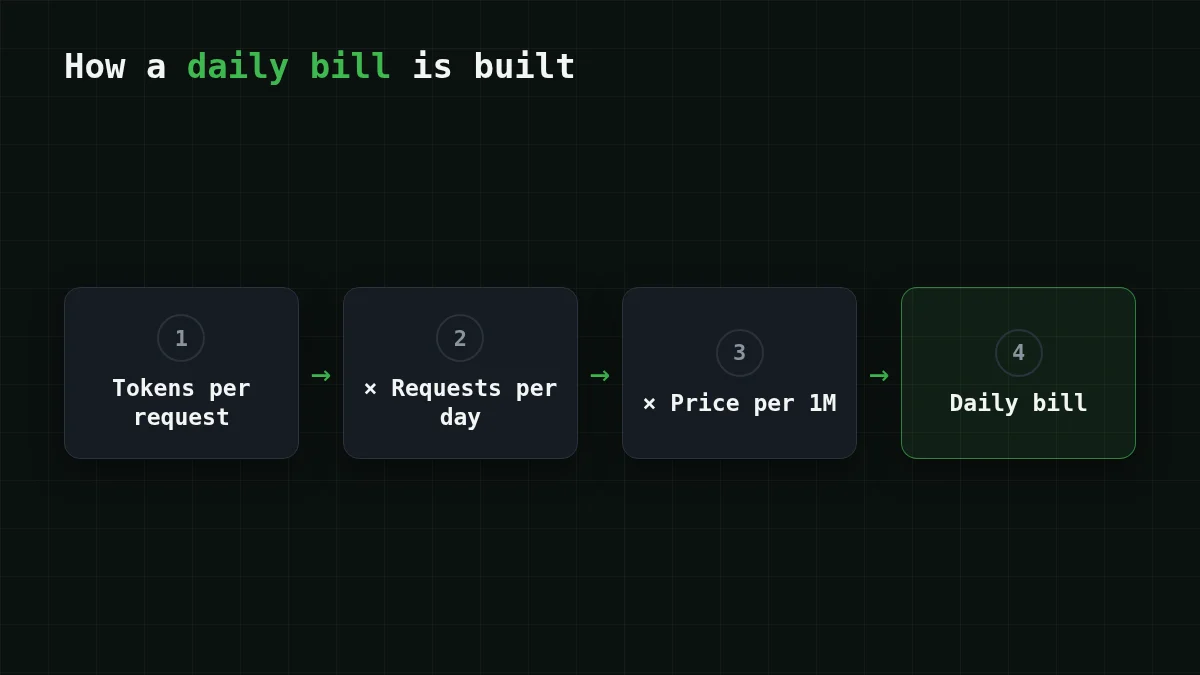
Price per 1M tokens is hard to feel. A task is easier. Say you run a support bot that summarises tickets: each request sends about 800 tokens in and gets about 300 tokens out. A thousand requests is then 0.8M input tokens and 0.3M output tokens. On Gemini's standard prices:
- Gemini 2.5 Flash-Lite: input 0.8 × $0.10 = $0.08, output 0.3 × $0.40 = $0.12, so $0.08 + $0.12 = $0.20 in total.
- Gemini 3.1 Flash-Lite: input 0.8 × $0.25 = $0.20, output 0.3 × $1.50 = $0.45, so $0.20 + $0.45 = $0.65 in total.
- Gemini 3.5 Flash-Lite: input 0.8 × $0.30 = $0.24, output 0.3 × $2.50 = $0.75, so $0.24 + $0.75 = $0.99 in total.
- Gemini 4 Argon: input 0.8 × $2.00 = $1.60, output 0.3 × $10.00 = $3.00, so $1.60 + $3.00 = $4.60 now, and 0.8 × $4.00 = $3.20 plus 0.3 × $20.00 = $6.00 makes $9.20 from 1 December.
See the pattern? The output price does the damage. The Flash-Lite generations differ little on input ($0.10 to $0.30) but output climbs from $0.40 to $2.50, and a short-answer workload feels it.
Now the same 1,000 requests through CheapTokens. One line first: MiniMax-M2.7 (MiniMaxAI/) runs this workload for $0.085. The live table below has all three models with OpenRouter's reference price next to them:
| Model | Input $/1M | Output $/1M | Per request | 1,000 requests | OpenRouter, 1,000 requests |
|---|---|---|---|---|---|
| GLM-5.3-Flash | $0.02 | $0.04 | $0.000028 | $0.028 | $0.0558 |
| DeepSeek-V4-Flash | $0.015 | $0.10 | $0.000042 | $0.042 | $0.085 |
| MiniMax-M2.7 | $0.05 | $0.15 | $0.000085 | $0.085 | $0.60 |
800 input and 300 output tokens per request. Prices per 1M tokens are current and change together with our tariffs; the OpenRouter column shows reference prices for the same workload.
The table recalculates from current prices every time the page loads, so it stays correct when the tariffs move. Input and output are counted together, and in that total all three CheapTokens models come in under OpenRouter's reference price. Gemini 2.5 Flash-Lite takes $0.20 for the same 1,000 requests; the table above shows the CheapTokens totals for exactly this workload, input and output together — read the two side by side.
The thinking-token trap#
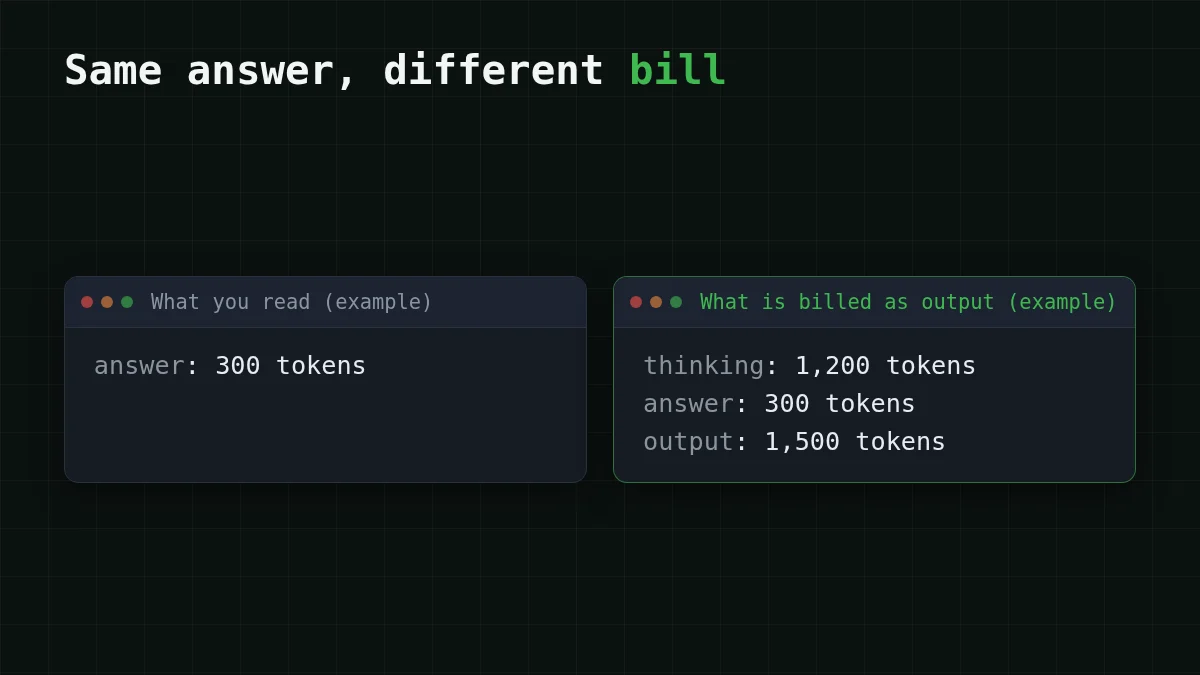
Back to that incl. thinking header. A model that thinks before answering writes extra tokens you never see, and Gemini bills them as output. Say each ticket summary triggers 1,200 thinking tokens on top of the 300-token answer. Output per request is now 1,500 tokens, so a thousand requests give 1.5 × $0.40 = $0.60 of output on 2.5 Flash-Lite, up from $0.12. Same visible answer, five times the output line.
Quick check
Your Gemini answer is 300 tokens long, but the bill shows 1,500 output tokens. What most likely happened?
Show answer
Answer: The model spent about 1,200 tokens thinking, and thinking is billed as output
Google's output column includes thinking tokens, so hidden reasoning shows up on the output side of the bill. Check the usage numbers on a few real responses before you estimate a month.
Which one to pick#
The right row depends on what you are doing, not on a single ranking.
Pick your case
Which setup fits your case?
Choose an option to see the answer
Prototype with very little traffic
Use the Gemini free tier on one of the models that has it. Treat it as a way to learn, and put the paid price of the same model in your budget before you ship.
Many short interactive requests
Gemini 2.5 Flash-Lite is the cheapest paid Gemini row. Compare the totals in the cost table above with Gemini's $0.20: DeepSeek-V4-Flash gives you a fixed price at any time of day, a 380K context and up to 32,768 output tokens per answer, with one balance across all models.
Big jobs that can wait
Gemini's Batch API halves the price, if you can live with asynchronous results. If you would rather get answers in the same request, GLM-5.3-Flash (390K context, up to 8,192 output tokens) is the low-cost small model in the table.
Coding agents and long loops
MiniMax-M2.7 is the CheapTokens model for agentic and coding work (180K context, up to 8,192 output tokens). Agent loops resend a lot of input, so measure a real run first; GLM vs DeepSeek vs MiniMax walks through how to choose between the three.
Price is only half of a pick. Run your own prompts on the two or three candidates and compare the answers before you switch anything.
Try the same request on CheapTokens#
The API is OpenAI- and Anthropic-compatible, so the call looks like any chat request. Get the model id from the docs — it differs between providers — and read usage in the reply: that gives you the real tokens per request for the table above.
curl https://api.cheaptokens.dev/v1/chat/completions \
  -H "Authorization: Bearer $CHEAPTOKENS_API_KEY" \
  -H "Content-Type: application/json" \
  -d '{"model": "deepseek-ai/DeepSeek-V4-Flash-0731", "messages": [{"role": "user", "content": "Summarise this ticket in one sentence: the invoice PDF will not download."}], "max_tokens": 300}'
Current prices for every model are on the pricing page, and the DeepSeek-V4-Flash model page has the model details.


