Models & comparisonsComparison
Inkling 2 Small vs DeepSeek-V4.1-Flash: which model for coding?
The vendor's table puts DeepSeek-V4.1-Flash ahead on most coding rows. How to read it, run a 5-prompt check on your repo and count cost per task.
On this page
Short answer: in the table Thinking Machines published for Inkling 2 Small (release page of 5 November 2026, checked 7 November), DeepSeek-V4.1-Flash-1017 is ahead on five of the six coding rows that show both models. Inkling leads on one, and it has a strong web-design rank. That is the vendor's own table, though, so treat it as a reason to run a small check on your code, not as a verdict.
If you saw a headline like "Inkling is close to DeepSeek" and wondered whether to switch your coding agent, this is the order to go in: read the rows that match your work, see what the table cannot show, run five prompts of your own, and put a cost on one finished task.
What Inkling 2 Small is#
According to the release page, Inkling 2 Small is the second-generation model from Thinking Machines Lab. It is a Mixture-of-Experts model with 594B parameters in total and 17B active per token. It accepts images (not audio) and has a variable effort setting. Right now it runs on Tinker, the lab's serverless inference service, which is in Beta.
Two details are easy to miss. The weights are closed for now: the lab plans to release them under Apache 2.0 "next week" after external safety testing, and says other platforms will follow "in the coming weeks". That is a plan, not a fact, until the files are actually out. And the context: the Tinker model list shows 256K as the maximum. The 512K and 1M figures on the release page are training and evaluation settings, not what you can send today.
Flashcards
Words you will meet in this comparison
Tap a card to flip it
The dates matter more than usual here, because half of the offer is a promise:
Timeline
Inkling 2 Small: what the vendor says and when
- 5 Nov 2026release page published, model live on Tinker (Beta)
- "Next week"planned open-weights release under Apache 2.0, after external safety testing
- "Coming weeks"availability on other platforms
Reading the table row by row#
The vendor compares Inkling 2 Small with DeepSeek-V4.1-Flash-1017. DeepSeek's docs say the deepseek-flash alias is now served by that version (page has no date, checked 7 November 2026). Here are the rows where both models have a number. The last column is just the subtraction.
Scroll the table right →
| Row | Inkling 2 Small | DeepSeek-V4.1-Flash-1017 | Gap, points |
|---|---|---|---|
| FrontierCode v2.0 | 25.4% | 28.5% | DeepSeek +3.1 |
| DeepSWE v1.1 | 72.1% | 77.0% | DeepSeek +4.9 |
| Vibe Code Bench v1.1 | 81.6% | 87.7% | DeepSeek +6.1 |
| Terminal Bench Science v0.1 | 5.7% | 12.9% | DeepSeek +7.2 |
| PostTrainBench v1.2 | 31.9% | 30.5% | Inkling +1.4 |
| PMPP-Hard (AUC) | 494.27 | 497.36 | DeepSeek +3.09 |
Check one: 77.0 - 72.1 = 4.9. Count the rows and DeepSeek is ahead on five, Inkling on one.
Guess the number
On how many of the six head-to-head rows is DeepSeek-V4.1-Flash-1017 ahead?
Your guess
06
Show answer
Answer: 5
Five: FrontierCode, DeepSWE, Vibe Code Bench, Terminal Bench Science and PMPP-Hard. Inkling is ahead only on PostTrainBench.
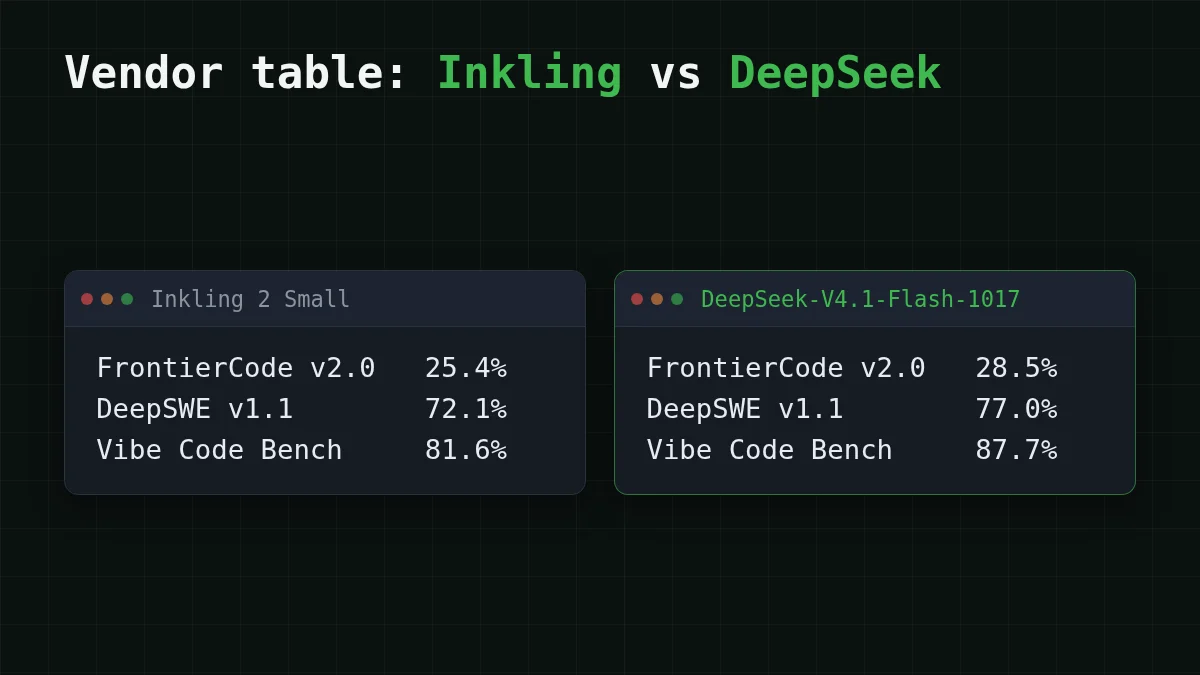
A few things to notice before you quote this table to your team.
- The biggest gap sits on the least mature row. Terminal Bench Science is at version 0.1, and 12.9% against 5.7% is more than double. It is a hint about terminal-style work, not a ruling.
- One row has no head-to-head. SWEBench Pro v2 (Hard) shows Inkling at 86.3% and DeepSeek as not reported. You cannot compare a number with a blank.
- Small gaps are small. A gap of 1.4 or 3.1 points on a benchmark you have never run may not survive a change of repo or prompt.
- The page contradicts itself once. The Artificial Analysis Intelligence Index is 31 in the text and 30.6 (v5.0) in the table, with no explanation. It is a minor thing, but it is a reminder to read footnotes.
Nothing here is independently replicated yet; all the numbers come from the Inkling vendor.
Web design is a different row#
If your task is generating websites rather than fixing bugs, the relevant number is DesignArena Website. In the 5 November snapshot on the release page, Inkling 2 Small scored 1,340, third behind Muse Wonder (1,366) and Muse Spark 1.3 (1,351). The vendor expects it to be the top open-weights model there once the weights are out. The gap to first place is 1,366 - 1,340 = 26 points.
That is a leaderboard of people comparing generated pages, so it says something real about looks. But the page gives no DeepSeek number for this row, so there is no head-to-head to read. Open DesignArena itself before relying on the snapshot.
What no table can show#
Say you maintain a ten-year-old Django monolith with slow tests and a lot of house rules. A benchmark made of fresh, tidy repos tells you little about how a model handles your utils.py with 3,000 lines. Four things are missing from any vendor table:
- Your code and your habits. Naming, test style, which files the agent should never touch.
- How the agent loop behaves. The same model can do well in one tool and badly in another, because tools differ in how they feed it files and errors.
- How many steps a task takes. A model that is 3 points better per attempt but needs more attempts is not necessarily better for you.
- Price. Inkling's per-token price is not on the release page or in the Tinker model list (checked 7 November 2026). Look at Tinker's pricing page and put the date next to whatever you find.
If you want a longer walk through reading benchmark tables, there is a separate piece: how to read an AI benchmark and run a 5-prompt test.
The 5-prompt check on your own code#
This takes an afternoon and beats any leaderboard for your decision. Pick five tasks you actually did in the last two weeks, each one with a way to tell if the answer is right. Send the same text to each model and score the result yourself.
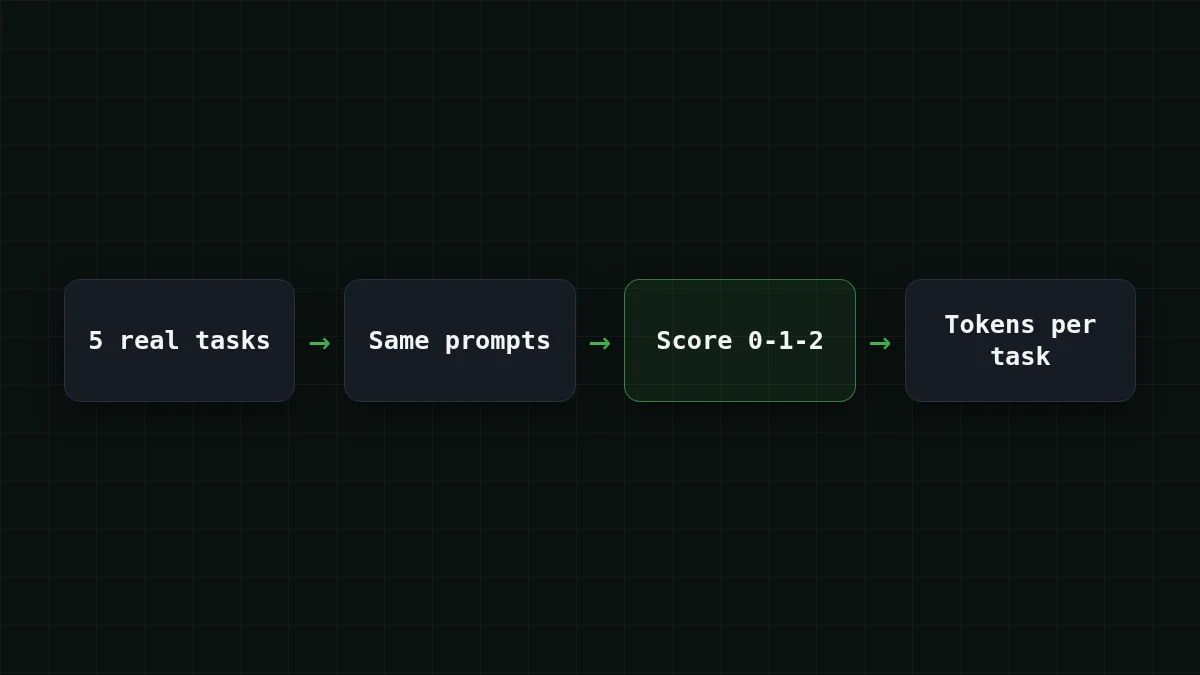
Checklist
Your 5-prompt check
For the models you can call over an OpenAI-compatible API, the loop is short. Put the five prompts in tasks.txt, separated by a line with =====. Read the full documentation in CheapTokens docs; the address is https:/.
import os
from openai import OpenAI

client = OpenAI(
    base_url='https://api.cheaptokens.dev/v1',
    api_key=os.environ['CHEAPTOKENS_API_KEY'],
)

tasks = open('tasks.txt').read().split('=====')
for i, task in enumerate(tasks, 1):
    r = client.chat.completions.create(
        model='deepseek-ai/DeepSeek-V4-Flash-0731',
        messages=[{'role': 'user', 'content': task.strip()}],
        max_tokens=4000,
    )
    u = r.usage
    print(i, u.prompt_tokens, u.completion_tokens, r.choices[0].finish_reason)
What you will see is five lines of task number, input tokens, output tokens, finish_. stop means the model finished on its own; length means max_tokens cut the answer. The model id here is the full one: deepseek-. A short id from a price table will not work.
DeepSeek-V4-Flash on CheapTokens has a 380K context, up to 32,768 tokens in one answer, one price at any time of day and an Anthropic-compatible endpoint as well, so the same five prompts also run through tools built on that format. The scores from your own five prompts are the ones that matter for your repo. For Inkling 2 Small, send the same five texts through Tinker.
Want a third and fourth contender on the same balance? GLM-5.3-Flash (zai-, 390K context) and MiniMax-M2.7 (MiniMaxAI/, 180K context) take the same call with another model value. If you want to see how the DeepSeek model compares with MiniMax on tasks, there is MiniMax-M2.7 vs DeepSeek-V4-Flash.
Cost per task, not per token#
A price per million tokens is not a price per finished task. What you pay is the number of steps times the tokens in each step, input and output counted together. Say your agent solves a bug in 20 steps, and each step sends about 30,000 tokens of files and history and gets about 1,500 tokens back. One step on DeepSeek-V4-Flash costs $0.0006. The whole task, on live prices:
| Model | Input $/1M | Output $/1M | Per request | 20 requests | OpenRouter, 20 requests |
|---|---|---|---|---|---|
| GLM-5.3-Flash | $0.02 | $0.04 | $0.00066 | $0.0132 | $0.0226 |
| DeepSeek-V4-Flash | $0.015 | $0.10 | $0.0006 | $0.012 | $0.0462 |
| MiniMax-M2.7 | $0.05 | $0.15 | $0.0017 | $0.0345 | $0.414 |
30,000 input and 1,500 output tokens per request. Prices per 1M tokens are current and change together with our tariffs; the OpenRouter column shows reference prices for the same workload.
That table also shows OpenRouter's reference price, and in total, with input and output counted together, DeepSeek-V4-Flash on CheapTokens comes out cheaper. Per-token rates for every model are on the pricing page.
Now the point that matters for the comparison. If model A solves the task in 20 steps and model B needs 30, then 30 / 20 = 1.5, so B costs one and a half times as much per task at the same token price. A few extra points on a benchmark can easily be eaten by extra steps, and the other way round. That is why the 5-prompt check records tokens: you will see steps and tokens per task, not only a score. The longer version of this idea is in price per 1M tokens vs cost per task.
Put your own numbers into the calculator. In the example below, 200 runs is 10 tasks a day at 20 steps each; change tokens per step to what your check showed.
Cost calculator
One day of a coding agent: 10 tasks, 20 steps each
Input tokens per request: 30,000 · Output tokens per request: 1,500 · Requests per day: 200
| Model | Per day | Per month |
|---|---|---|
| GLM-5.3-Flash$0.02$0.04 | $0.132 | $3.96 |
| DeepSeek-V4-Flash$0.015$0.10 | $0.12 | $3.60 |
| MiniMax-M2.7$0.05$0.15 | $0.345 | $10.35 |
Which to pick#
A coding agent on a real repo. On the vendor's own coding rows DeepSeek-V4.1-Flash-1017 is ahead on most. Start the check with DeepSeek-V4-Flash (id in the code above) and add Inkling to the same five prompts. Switch only if Inkling wins on your tasks, not on the vendor's. If you want the background on the DeepSeek release itself, see what changed in deepseek-flash.
Websites and front-end generation. Inkling's DesignArena Website rank is the strongest claim in the release. Run two or three of your own page prompts on both models and look at the pages, not the numbers.
Self-hosting later. Inkling is the one with an open-weights plan, under Apache 2.0. Until the files exist, it is a plan. Check the release page again before you build anything around it, and meanwhile you can run the same prompts against a hosted model with DeepSeek on CheapTokens.
One more tip, if you decide by tasks: keep the five prompts and the scoring sheet. Next time a vendor publishes a table, you rerun the check in an hour instead of reading rankings again.


