AI newsUpdate
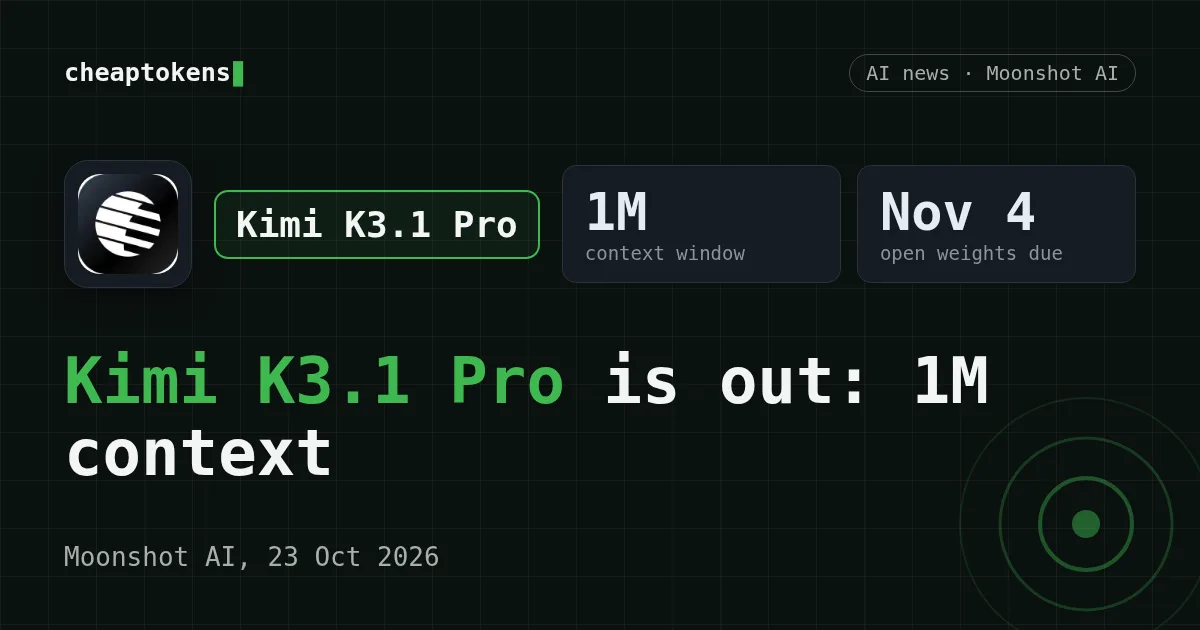
Kimi K3.1 Pro is out: 1M context, open weights due Nov 4
What Moonshot AI's Kimi K3.1 Pro brings: 1M-token context, vendor benchmarks, API ids and open weights by Nov 4 — and what a long agent run costs.
On this page
Moonshot AI released Kimi K3.1 Pro on 23 October 2026: a model with a 1,048,576-token context window, aimed at agentic and coding work, with full open weights promised by 4 November. The API price is the one thing missing: on the pages we checked on 23 October it is not published.
So if you came for a quick verdict, here it is: interesting model, strong vendor numbers, no way yet to price a workload on it. Below is what the announcement actually says, how to read the benchmarks, and a cost calculation for the same kind of work on models you can run today.
What Moonshot announced#
The Kimi K3.1 Pro announcement (checked 23 October 2026) says K3.1 Pro is the first model of the K3.1 series. There is also a faster variant, Kimi K3.1 Pro Highspeed, which Moonshot describes as 2–3× faster. The API ids are kimi-k3.1-pro and kimi-.
Moonshot calls it a "3T-class open-weight model" and says full weights arrive by 4 November 2026. A Telegram retelling quotes an exact parameter count; the official page does not, so treat that number as unconfirmed.
Where you can use it today, per the announcement: Kimi.ai and the apps, Kimi Work desktop 3.1.0+, Kimi Code (via /model), the Kimi API (with Zero Data Retention for API customers) and Kimi Business, where an enterprise admin has to switch it on — it is off by default at launch.
Limits and API details#
The quickstart (checked 23 October 2026) gives these numbers:
- context window: 1,048,576 tokens;
max_: 131,072 by default, up to 1,048,576;completion_ tokens - flat per-token pricing, no context tiers;
- automatic context caching with a 5-minute default TTL; cache writes are billed by TTL (5 minutes or 1 hour), cached input at the cache-hit price;
- base URL
https:/, with examples for the OpenAI SDK./ api. moonshot. ai/ v1
About the price. The pricing page returned empty tables for K3.1 Pro when we looked on 23 October. No input, cache or output price is public yet, so any "Kimi K3.1 Pro costs X" you see today is a guess.
The benchmarks, and how to read them#
All of these are Moonshot's own numbers, run at maximum reasoning effort, temperature 1.0, top-p 0.95:
- Terminal-Bench 4.0: 65.7% (GPT-6 Astra 58.2%, Claude Opus 5.5 66.4%);
- BenchCAD with tools: 92.7% (Opus 5.5 96.2%, GPT-6 Astra 95.9%);
- Kimi Code Bench 3.0, long-horizon: 61.2% against 55.95% for K3;
- claim-level hallucination rate on Moonshot's internal Kimi Hallu Bench Hard: 8.3%, down from 23.4% for K3.
Read that as: close to the top on terminal tasks, behind on CAD, and a big claimed drop in made-up claims versus its predecessor. Two of the four are internal Moonshot benchmarks, so wait for independent runs before you rebuild anything around them. Moonshot also says it removed cyber-related data from mid-training and reinforcement learning to limit offensive cyber capability.
What this means for your agent bill#
A 1M window matters when your agent keeps a lot of context: repository files, tool output, long history. But most agent loops do not need a million tokens per call; they need a few tens of thousands, repeated many times. That is where the bill comes from, and you can price it today.
Say your agent runs 1,000 steps, and each step sends 30,000 tokens of context and gets 800 tokens back. That is 30,000 × 1,000 = 30,000,000 input tokens and 800 × 1,000 = 800,000 output tokens. The table prices exactly that on the models available in CheapTokens, next to the OpenRouter reference:
| Model | Input $/1M | Output $/1M | Per request | 1,000 requests | OpenRouter, 1,000 requests |
|---|---|---|---|---|---|
| GLM-5.3-Flash | $0.02 | $0.04 | $0.00063 | $0.632 | $1.30 |
| DeepSeek-V4-Flash | $0.015 | $0.10 | $0.00053 | $0.53 | $1.55 |
| MiniMax-M2.7 | $0.05 | $0.15 | $0.0016 | $1.62 | $9.96 |
30,000 input and 800 output tokens per request. Prices per 1M tokens are current and change together with our tariffs; the OpenRouter column shows reference prices for the same workload.
For agentic and coding loops, MiniMax-M2.7 is the straightforward pick: in the facts we checked on 23 October 2026, both its input and its output are cheaper than OpenRouter's reference, with a 180K context and up to 8,192 output tokens per answer. One step of this workload costs $0.0016.
The prices come from the live price list, so the numbers above refresh when tariffs change. To see the models side by side, open the pricing page; for a step-by-step estimate of your own loop, see how to estimate the cost of an AI agent.
Try the same workload yourself#
The CheapTokens API is OpenAI-compatible, so an existing client only needs a new base URL and a model id. The full id is required; the short name from the price list is not accepted:
curl https://api.cheaptokens.dev/v1/chat/completions \
  -H "Authorization: Bearer $CHEAPTOKENS_API_KEY" \
  -H "Content-Type: application/json" \
  -d '{
    "model": "MiniMaxAI/MiniMax-M2.7",
    "messages": [{"role": "user", "content": "List the files you would read first in a Python repo with a failing test."}],
    "max_tokens": 400
  }'
The response carries a usage block with input and output tokens. Multiply those by your step count and you have your own version of the table above. Setup details are in the docs; if you are choosing between the three models, GLM vs DeepSeek vs MiniMax walks through it by task.
What to watch next#
- The price. Re-check the Kimi pricing page: once input, cache and output prices appear, you can run the same 1,000-step calculation on them.
- 4 November. The open weights. Independent evaluations usually follow within days.
- Highspeed. Its price and context window are not confirmed separately from K3.1 Pro.
One rule of thumb for any new long-context model: price your real step (context in, answer out) before you get excited about the window size.


