Models & comparisonsComparison
Cheapest model for OpenClaw: what a day of agent work costs
Which model to run OpenClaw on: GLM-5.3-Flash, DeepSeek-V4-Flash or MiniMax-M2.7. Pick by task and see what a day of agent work costs.
On this page
Your OpenClaw agent has been answering messages all day, and the bill is bigger than the task. Usually that isn't the model's fault. It's what the agent asks of it: a short chat reply and a twenty-step tool run are very different jobs on the same price list.
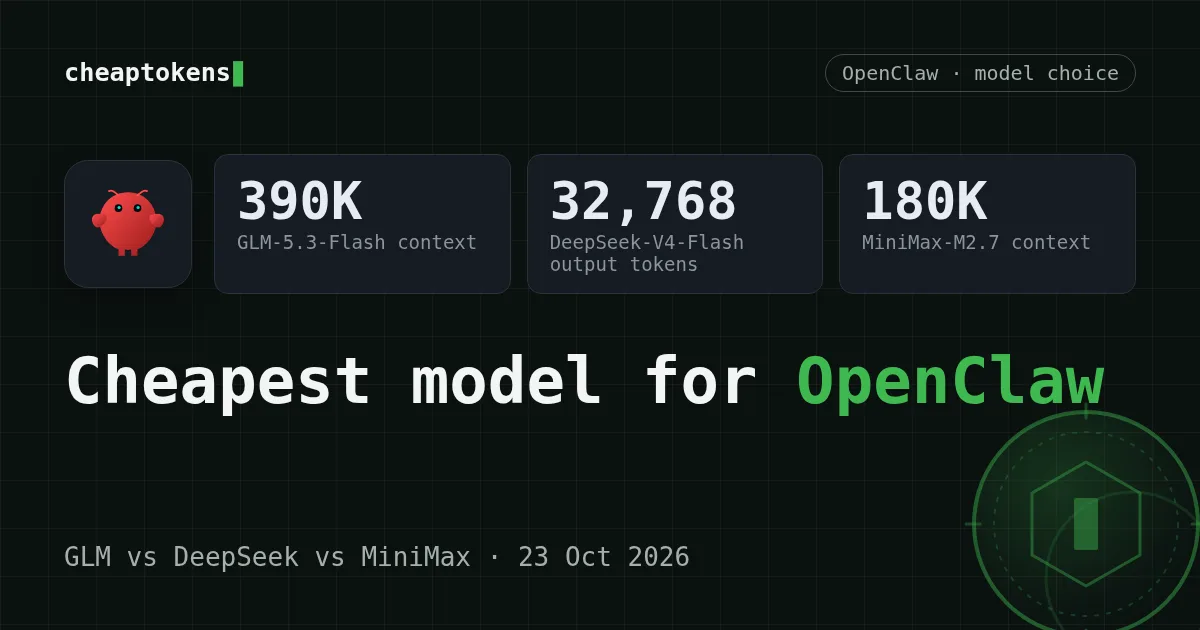
Short answer. For plain chat turns, start with GLM-5.3-Flash: on the chat load in the first cost table below it comes out cheaper than OpenRouter in total, with input and output counted together. For tool loops and long sessions, DeepSeek-V4-Flash (380K context) and GLM-5.3-Flash (390K) have the room. If the agent writes long reports, only DeepSeek-V4-Flash fits up to 32,768 tokens into one answer; the other two stop at 8,192. Every price and daily cost below is a live figure, the same one as on the pricing page.
What you are choosing between#
OpenClaw's docs, as of 23 October 2026, describe it as a self-hosted, MIT-licensed gateway: one process on your machine or server connects Discord, Telegram, Signal and WhatsApp to an AI agent. The default model is a single line in ~/, agents., written as provider/model. The setup itself is in how to connect OpenClaw to CheapTokens. Here is only the choice of model.
Three models on CheapTokens fit an always-on agent. They share the same API (https:/, OpenAI- and Anthropic-compatible), one balance and one price at any hour, with no peak-hour surcharge:
- GLM-5.3-Flash (
zai-): 390K context, up to 8,192 output tokens per answer, cheaper than OpenRouter on output.org/ GLM- 5. 3- Flash - DeepSeek-V4-Flash (
deepseek-): 380K context, up to 32,768 output tokens per answer.ai/ DeepSeek- V4- Flash- 0731 - MiniMax-M2.7 (
MiniMaxAI/): 180K context, up to 8,192 output tokens per answer.MiniMax- M2. 7
Context and output limits are from the CheapTokens model reference, 23 October 2026. Prices are not quoted here as numbers: they come from the tables below.
A day of chat: many short turns#
Say your agent answers 200 messages a day in Telegram. Each turn sends about 2,000 tokens in (system prompt plus the recent history) and gets about 300 tokens back. That is 200 × 2,000 = 400,000 input tokens and 200 × 300 = 60,000 output tokens per day.
| Model | Input $/1M | Output $/1M | Per request | 200 requests | OpenRouter, 200 requests |
|---|---|---|---|---|---|
| GLM-5.3-Flash | $0.02 | $0.04 | $0.000052 | $0.0104 | $0.0211 |
| DeepSeek-V4-Flash | $0.015 | $0.10 | $0.00006 | $0.012 | $0.0284 |
| MiniMax-M2.7 | $0.05 | $0.15 | $0.00015 | $0.029 | $0.192 |
2,000 input and 300 output tokens per request. Prices per 1M tokens are current and change together with our tariffs; the OpenRouter column shows reference prices for the same workload.
The OpenRouter column is the same day at OpenRouter's reference price. DeepSeek-V4-Flash and MiniMax-M2.7 come out cheaper than OpenRouter in total, with input and output counted together. GLM-5.3-Flash is cheaper than OpenRouter in total on this chat load too. Change the two numbers to your own traffic and the table recalculates.
A day with tools: the history is the bill#
Now the same agent with tools. Say it runs 150 steps a day. Every step re-sends the instructions, the tool descriptions and everything that happened so far, so a step carries about 12,000 tokens in and writes about 600 out. That is 150 × 12,000 = 1,800,000 input tokens and 150 × 600 = 90,000 output tokens.
Input here is twenty times the output, so the history, not the answers, sets the bill. On this load DeepSeek-V4-Flash and MiniMax-M2.7 are cheaper than OpenRouter in total. GLM-5.3-Flash brings the largest window, 390K, and cheap output for the replies the agent does write. Why history grows the input every turn is in why a long AI chat costs more, and the method for any agent is in how to estimate the cost of an AI agent.
Long answers: where 8,192 tokens runs out#
Suppose you ask the agent for a weekly report of about 12,000 tokens. DeepSeek-V4-Flash allows up to 32,768 output tokens per answer, so the report arrives whole. GLM-5.3-Flash and MiniMax-M2.7 stop at 8,192: the answer ends mid-sentence and the response carries finish_. You can ask them for the report in sections, but that is two or three calls instead of one. Why answers cut off explains the field.
A 12,000-token report from a 6,000-token prompt costs $0.0013 on DeepSeek-V4-Flash.
Long sessions: how much window is left#
Say a support conversation has piled up 150,000 tokens of history. MiniMax-M2.7 has a 180K window: 180K − 150K = 30K left for the new message and the answer. DeepSeek-V4-Flash has 380K − 150K = 230K left, GLM-5.3-Flash 390K − 150K = 240K. If your sessions stay short, all three are fine. If an agent keeps one thread for days, the bigger windows give it room.
Which one for which job#
- Many short chat turns: GLM-5.3-Flash, cheaper than OpenRouter in total on the chat load above. MiniMax-M2.7 suits sessions that stay well under 180K.
- Tool loops and long sessions: DeepSeek-V4-Flash (380K, cheaper than OpenRouter in total) or GLM-5.3-Flash (390K, cheap output).
- Long reports and code in one answer: DeepSeek-V4-Flash, up to 32,768 tokens.
- Not sure: DeepSeek-V4-Flash covers the most ground, with a big window and the longest answers.
All three are on the pricing page; the model pages are DeepSeek, GLM and MiniMax. For a head-to-head outside the agent case, see GLM vs DeepSeek vs MiniMax.
Try it on your own traffic#
My 200 messages and 150 steps are assumptions, yours are better. Send one typical message to the model and read the usage block of the response: prompt_tokens is what you sent, completion_ is what came back. Multiply by your daily count and put the numbers into ::cost. The key below is a placeholder.
curl https://api.cheaptokens.dev/v1/chat/completions \
  -H "Authorization: Bearer $CHEAPTOKENS_API_KEY" \
  -H "Content-Type: application/json" \
  -d '{"model": "deepseek-ai/DeepSeek-V4-Flash-0731", "messages": [{"role": "user", "content": "Summarize this chat in one line."}], "max_tokens": 100}'
Switching OpenClaw is the one line agents.; the provider block is in the connection guide. After switching, run for a day and compare the cost from the usage block on your own traffic.
To start, top up the balance and create a key, as the docs describe.


